Introduction
When travelers think about tourism in Medellín, they usually picture Comuna 13, El Poblado, Pueblito Paisa, the Botanical Garden, or Arví Park. These attractions have earned worldwide recognition thanks to their vibrant atmosphere and unique experiences.
However, beyond these famous landmarks lies a neighborhood that tells a much older story—a place where the architectural elegance of the early twentieth century still defines the urban landscape and where every street reveals another chapter in Medellín’s remarkable transformation.
That neighborhood is Prado Centro.
As Medellín’s only officially recognized heritage district, Prado Centro represents one of Colombia’s most significant examples of urban conservation. Here, visitors can admire beautifully preserved mansions, stroll beneath mature trees lining broad avenues, discover remarkable architectural styles, enjoy world-class cultural venues, and experience one of the city’s most ambitious heritage revitalization projects.
Unlike many historic neighborhoods that have become static museums, Prado Centro continues to evolve. Historic residences have been transformed into restaurants, art galleries, cultural centers, boutique businesses, cafés, educational institutions, and creative workspaces, allowing visitors to experience history while participating in the neighborhood’s modern cultural life.
Visiting Prado Centro is more than simply observing historic buildings—it is about understanding the origins of modern Medellín.
The History of Prado Centro
The origins of Prado Centro date back to the beginning of the twentieth century, a period during which Medellín experienced unprecedented economic growth fueled by the textile industry, coffee exports, banking, and commercial development.
As prosperity increased, the city’s wealthiest families sought to move away from the increasingly crowded colonial downtown. Inspired by European urban planning principles and modern residential developments in North America, they envisioned an elegant neighborhood characterized by spacious avenues, landscaped gardens, and luxurious residences.
Thus, Prado was born.
Urban planners designed wide streets that encouraged airflow and natural light, while architects incorporated influences from France, Italy, England, Germany, and other European countries. The result was an extraordinary collection of residences reflecting the optimism and economic confidence of Medellín’s elite.
Throughout the first half of the twentieth century, Prado became the city’s most prestigious residential district. Industrialists, politicians, entrepreneurs, physicians, lawyers, and influential families built magnificent homes showcasing imported materials, handcrafted decorative elements, and architectural styles rarely found elsewhere in Colombia.
Many of these residences featured:
- Marble staircases
- Ornamental balconies
- Stained-glass windows
- Decorative plaster ceilings
- Hardwood floors
- Imported ceramic tiles
- Elegant gardens
- Large reception halls
These homes were not only symbols of wealth but also represented Medellín’s growing international outlook during a period of rapid modernization.
As the city expanded throughout the second half of the twentieth century, affluent residents gradually relocated to newer neighborhoods such as El Poblado and Laureles. Prado experienced significant social and economic changes, and many historic buildings were adapted for institutional, educational, or commercial purposes.
Fortunately, the neighborhood’s extraordinary architectural value was eventually recognized, leading to heritage protection measures that preserved a substantial portion of its historic urban fabric.
Today, Prado Centro stands as one of Medellín’s most important cultural treasures.
Why Prado Centro Is Medellín’s Only Official Heritage Neighborhood
Prado Centro enjoys a unique distinction within Medellín because it is the city’s only officially designated heritage neighborhood.
This recognition is based on several exceptional characteristics:
- It preserves much of its original urban design.
- It contains a large concentration of protected historic buildings.
- It represents Medellín’s architectural evolution during the early twentieth century.
- It serves as a permanent center for artistic and cultural activities.
- It houses important educational, religious, and institutional landmarks.
- It reflects the city’s transition from a provincial town into an industrial and commercial capital.
Walking through Prado Centro feels like visiting an open-air architectural museum.
Every block reveals a different chapter of Medellín’s history.
Every façade tells a story of ambition, innovation, craftsmanship, and cultural exchange.
Unlike reconstructed historical attractions, Prado Centro remains a living neighborhood where residents, businesses, artists, educators, and visitors interact daily, giving the district an authenticity rarely found in urban heritage destinations.
Architecture That Captivates Every Visitor
One of Prado Centro’s greatest attractions is undoubtedly its remarkable architecture.
The neighborhood showcases an extraordinary variety of architectural styles, demonstrating the international influences that shaped Medellín during the first decades of the twentieth century.
Visitors can admire buildings inspired by:
- French Neoclassical architecture
- Italian Renaissance design
- Victorian influences
- Art Nouveau
- Art Deco
- Eclectic architecture
- Republican architecture
- Early Modernism
Walking from one street to another often feels like traveling across Europe without leaving Colombia.
Many residences feature details that are increasingly rare in contemporary construction, including:
- Monumental staircases
- Handcrafted wrought-iron balconies
- Decorative ceramic flooring
- Original hardwood doors
- Ornamental ceilings
- Interior courtyards
- Classical columns
- Elaborate façades
- Decorative cornices
- Colorful stained-glass windows
Several of these historic mansions have undergone meticulous restoration projects that preserve their original character while adapting them for modern uses.
Today, visitors will find heritage buildings functioning as restaurants, boutique hotels, cafés, educational institutions, creative offices, museums, and cultural organizations.
This successful combination of preservation and adaptive reuse has become one of Prado Centro’s defining characteristics.
Rather than allowing historic buildings to deteriorate, the neighborhood has embraced innovative ways of giving them new life while respecting their historical significance.
As a result, Prado Centro offers an immersive experience where history is not confined to museums—it surrounds visitors at every step of their journey.
Salón Prado: A Cultural Landmark in the Heart of the Neighborhood
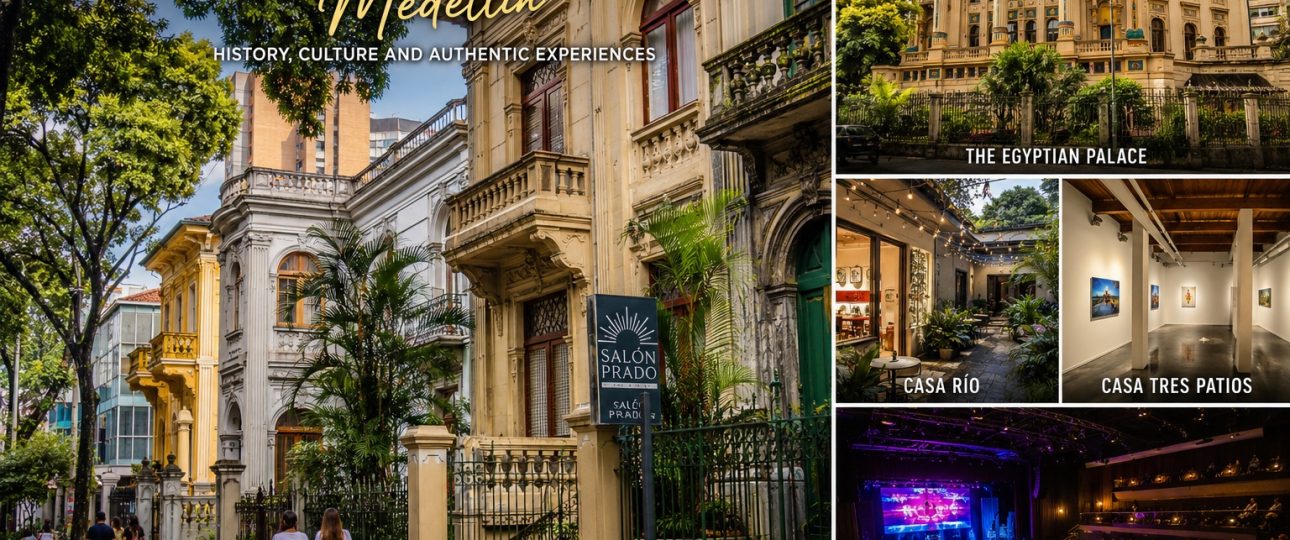
Among Prado Centro’s most representative cultural spaces is Salón Prado, a venue that has become a symbol of the neighborhood’s ongoing revitalization and commitment to preserving Medellín’s artistic heritage.
Rather than serving as a traditional museum, Salón Prado functions as a dynamic cultural hub where history, creativity, and community engagement intersect. Throughout the year, it hosts a diverse calendar of activities that attract residents, artists, students, historians, and visitors from around the world.
Its programming typically includes:
- Art exhibitions
- Photography showcases
- Heritage conferences
- Live music performances
- Literary gatherings
- Community workshops
- Cultural festivals
- Public discussions about urban preservation
One of the greatest strengths of Salón Prado is its ability to connect Medellín’s past with its present. Visitors not only learn about the neighborhood’s historical importance but also experience the creativity that continues to shape its future.
The venue has become a meeting point for architects, historians, designers, artists, and entrepreneurs who share a common goal: preserving Prado Centro while encouraging sustainable urban development.
For travelers seeking authentic cultural experiences beyond traditional sightseeing, Salón Prado offers an excellent opportunity to engage directly with Medellín’s creative community.
The Fascinating Egyptian Palace
Few buildings in Colombia generate as much curiosity as the Egyptian Palace (Palacio Egipcio).
Located in Prado Centro, this extraordinary mansion stands out immediately thanks to its unique architectural style, which differs dramatically from the surrounding European-inspired residences.
Constructed during the early twentieth century, the palace reflects the fascination with Ancient Egypt that spread across Europe and the Americas following major archaeological discoveries, particularly after the opening of Tutankhamun’s tomb.
The building incorporates numerous decorative elements inspired by Egyptian civilization, including:
- Hieroglyphic motifs
- Lotus-inspired columns
- Symbolic relief sculptures
- Egyptian ornamental patterns
- Monumental entrances
- Decorative friezes
- Ancient-inspired iconography
Its façade immediately captures the attention of pedestrians and photographers alike.
Although many visitors initially assume the building is a museum, the Egyptian Palace is primarily appreciated for its architectural significance and historical uniqueness.
Today it remains one of Medellín’s most photographed heritage buildings and an essential stop for architecture enthusiasts.
Its existence demonstrates the cosmopolitan aspirations of Medellín’s upper class during the early twentieth century, when international artistic movements heavily influenced local architecture.
The Egyptian Palace also illustrates how global cultural trends reached Colombia, inspiring ambitious architectural projects that continue to surprise visitors more than a century later.
Casa Río: Where Heritage Meets Gastronomy
One of the most successful examples of heritage restoration in Prado Centro is Casa Río.
Originally built as a private mansion, this beautifully restored property has evolved into one of the neighborhood’s most attractive destinations for visitors seeking an experience that combines architecture, gastronomy, design, and culture.
Rather than altering the building’s historic character, the restoration carefully preserved its original architectural features while adapting the interior to accommodate contemporary businesses.
Today, Casa Río offers visitors:
- Specialty coffee shops
- Fine dining restaurants
- Artisan bakeries
- Creative culinary experiences
- Cultural events
- Design exhibitions
- Community gatherings
The atmosphere reflects the perfect balance between historical preservation and modern innovation.
Visitors can enjoy locally roasted Colombian coffee while sitting beneath original ceilings that have witnessed more than a century of Medellín’s history.
The gardens and interior courtyards create peaceful spaces that contrast with the city’s urban energy, making Casa Río an ideal location to relax after exploring Prado Centro on foot.
For food lovers, Casa Río demonstrates how heritage buildings can become vibrant culinary destinations without sacrificing their architectural integrity.
Every meal becomes part of a broader cultural experience.
Casa Tres Patios: A Laboratory for Contemporary Art
Prado Centro is not only about preserving the past—it is also about encouraging creativity and experimentation.
One of the neighborhood’s most influential cultural institutions is Casa Tres Patios, an internationally recognized center dedicated to contemporary art, research, education, and cultural exchange.
Unlike conventional galleries, Casa Tres Patios functions as an artistic laboratory where ideas are developed through collaboration between local and international artists.
Its activities include:
- Contemporary art exhibitions
- Artist residency programs
- Research initiatives
- Educational workshops
- Public lectures
- Community engagement projects
- Experimental artistic practices
- Interdisciplinary collaborations
Many exhibitions are open to the public, allowing visitors to experience cutting-edge artistic expressions while interacting with creators from diverse backgrounds.
The institution plays a vital role in Medellín’s cultural ecosystem by encouraging dialogue between art, society, education, and urban development.
Visitors interested in contemporary culture often discover that Casa Tres Patios offers experiences unlike those found in traditional museums.
Each exhibition reflects current social issues, artistic innovation, and the evolving identity of Medellín as a city committed to creativity.
The presence of Casa Tres Patios reinforces Prado Centro’s reputation as one of Medellín’s most dynamic cultural districts.
Águila Descalza Theatre: A Stage for Colombian Humor and Performing Arts
No cultural visit to Prado Centro would be complete without experiencing the Águila Descalza Theatre.
For decades, this theater has been one of Medellín’s most beloved performing arts venues and a cornerstone of Colombian theater.
It is particularly famous for productions that combine intelligent humor, social commentary, regional traditions, and everyday Colombian life.
The theater regularly presents:
- Comedy performances
- Dramatic productions
- Family shows
- Cultural festivals
- Stand-up comedy
- Musical performances
- Educational programs
- Independent theater productions
Many performances explore the customs, language, and identity of the Paisa region, allowing visitors to better understand local culture through laughter and storytelling.
Unlike large commercial theaters, Águila Descalza maintains an intimate atmosphere that creates a close connection between performers and audiences.
Its productions have become an essential part of Medellín’s cultural identity and have earned recognition throughout Colombia.
Even travelers with limited Spanish proficiency often appreciate the expressive performances, visual storytelling, and energetic atmosphere that characterize the theater’s productions.
Attending a performance offers far more than entertainment—it provides a window into Colombian society, humor, traditions, and cultural values.
Walking Through Prado Centro: The Best Way to Experience Its Heritage
Prado Centro was designed long before automobiles dominated urban planning.
Its broad sidewalks, tree-lined streets, elegant intersections, and carefully planned avenues invite visitors to slow down and experience the neighborhood on foot.
Walking remains the best way to appreciate the district’s countless architectural details.
Every street reveals something new:
- Beautifully restored mansions
- Historic educational institutions
- Religious buildings
- Decorative façades
- Hidden gardens
- Sculptures
- Historic plaques
- Artistic murals
- Independent cafés
- Boutique businesses
Unlike many tourist attractions that can be visited quickly, Prado Centro rewards slow exploration.
Taking time to observe architectural details such as handcrafted ironwork, carved wooden doors, stained-glass windows, ornamental balconies, and decorative cornices transforms an ordinary walk into an immersive historical experience.
Visitors are encouraged to bring a camera, wear comfortable shoes, and allow themselves time to wander without a strict schedule.
One of Prado Centro’s greatest pleasures lies in unexpected discoveries.
A quiet street may suddenly reveal a magnificent mansion.
A restored residence may house an exceptional café.
An unassuming doorway may lead to a contemporary art exhibition.
This sense of discovery is one of the reasons why many travelers consider Prado Centro one of Medellín’s most authentic neighborhoods.
Architecture as a Living Museum
Unlike traditional museums, where history is displayed behind glass, Prado Centro presents architecture as a living part of everyday urban life.
People continue to live, work, study, create, and socialize within many of the neighborhood’s historic buildings.
This coexistence between heritage conservation and contemporary life creates a unique atmosphere rarely found in Latin American cities.
Visitors quickly realize that Prado Centro is not frozen in time.
Instead, it continues to evolve while honoring its architectural legacy.
Every restored building contributes to the ongoing story of Medellín—a city that has repeatedly demonstrated its ability to reinvent itself while respecting its historical roots.
For architecture enthusiasts, historians, photographers, and culturally curious travelers, Prado Centro offers one of the richest urban experiences in Colombia.
A Growing Gastronomic Scene
Over the past decade, Prado Centro has become one of Medellín’s emerging culinary destinations. As historic mansions have been restored and repurposed, many have found a new life as restaurants, cafés, bakeries, and specialty coffee shops, blending architectural heritage with innovative dining experiences.
Visitors can enjoy a diverse range of culinary options, including:
- Traditional Antioquian cuisine
- Colombian regional specialties
- International cuisine
- Contemporary fusion restaurants
- Specialty coffee houses
- Artisan bakeries
- Gourmet desserts
- Farm-to-table dining experiences
One of the neighborhood’s greatest attractions is that many of these establishments operate inside beautifully restored heritage buildings. Dining in Prado Centro is therefore much more than enjoying a meal—it is an opportunity to experience the city’s architectural legacy firsthand.
Local chefs and entrepreneurs have embraced the neighborhood’s historical character, creating spaces where original hardwood floors, decorative ceilings, antique staircases, and elegant courtyards complement modern culinary concepts.
For coffee enthusiasts, Prado Centro offers several cafés serving premium Colombian coffee sourced from the country’s renowned coffee-growing regions. Visitors can learn about brewing methods, coffee origins, and tasting techniques while relaxing in some of Medellín’s most charming historic settings.
Whether you are looking for a traditional lunch, a gourmet dinner, or simply an excellent cup of coffee, Prado Centro provides options that appeal to every traveler.
A Vibrant Cultural Destination
Culture is one of Prado Centro’s defining characteristics.
Throughout the year, the neighborhood hosts a wide variety of artistic and community events that celebrate Medellín’s creativity and multicultural identity.
Visitors may encounter:
- Art exhibitions
- Photography festivals
- Open-air concerts
- Heritage walking tours
- Literary gatherings
- Design fairs
- Artisan markets
- Community celebrations
- Educational workshops
- Public lectures
Many of these activities are organized by local cultural organizations, universities, neighborhood associations, and independent artists committed to preserving Prado Centro’s historical significance.
Unlike conventional tourist attractions, these events provide opportunities for genuine interaction between visitors and the local community.
Travelers interested in authentic cultural experiences often discover that participating in neighborhood activities offers a much deeper understanding of Medellín than simply visiting major landmarks.
The district has become an important meeting place where tradition and innovation coexist, creating an atmosphere that continually evolves while remaining rooted in its rich history.
A Paradise for Urban Photography
Prado Centro is one of Medellín’s most photogenic neighborhoods.
Its architectural diversity, wide avenues, mature trees, colorful façades, and carefully restored buildings make it an exceptional destination for photographers of all skill levels.
Some of the neighborhood’s most appealing photographic subjects include:
- Historic mansions
- Decorative balconies
- Tree-lined streets
- Ornamental façades
- Stained-glass windows
- Interior courtyards
- Churches
- Public sculptures
- Cultural centers
- Architectural details
The best times for photography are generally early in the morning and during the late afternoon, when natural light enhances the textures and decorative elements of the buildings.
Golden hour creates particularly beautiful lighting conditions, highlighting the warm colors of Prado Centro’s historic architecture.
Architectural photographers may wish to bring a wide-angle lens to capture the grandeur of the neighborhood’s large residences, while portrait photographers will find numerous picturesque backgrounds for lifestyle and travel photography.
Because Prado Centro remains an active residential and commercial neighborhood, visitors should always respect people’s privacy and request permission before photographing individuals.
How to Get to Prado Centro
One of Prado Centro’s greatest advantages is its excellent accessibility.
The neighborhood is conveniently connected to Medellín’s efficient public transportation network, making it easy for both residents and visitors to reach.
The most convenient way to arrive is by using the Medellín Metro.
Visitors can begin their walking tour from either of the following stations:
- Prado Station
- Hospital Station
Both stations are located within walking distance of the neighborhood’s principal attractions.
In addition to the Metro, Prado Centro is served by:
- Urban bus routes
- Taxi services
- Ride-sharing applications
- Bicycle routes
- Pedestrian-friendly streets
Travelers staying in neighborhoods such as El Poblado, Laureles, Envigado, or Belén can easily reach Prado Centro using Medellín’s integrated public transportation system.
The neighborhood’s central location also makes it an excellent addition to a full-day itinerary that includes other nearby attractions such as the Botanical Garden, Explora Park, the Museum of Antioquia, Plaza Botero, and downtown Medellín.
Suggested One-Day Itinerary
Visitors can comfortably explore Prado Centro in a single day while enjoying its principal attractions at a relaxed pace.
9:00 AM – Arrive at Prado Metro Station
Begin your visit by walking through the neighborhood’s historic streets while appreciating its elegant architecture and peaceful atmosphere.
9:30 AM – Heritage Walking Tour
Explore the neighborhood’s most beautiful residential streets, observing architectural styles, historic façades, decorative balconies, and landscaped avenues.
Take your time to photograph the buildings and appreciate the craftsmanship that defines Prado Centro.
10:30 AM – Visit the Egyptian Palace
Stop at the remarkable Egyptian Palace to admire one of Colombia’s most unusual architectural landmarks.
Its distinctive façade offers countless photographic opportunities.
12:00 PM – Lunch at Casa Río
Enjoy lunch in one of Prado Centro’s beautifully restored heritage buildings.
Take time to experience both the cuisine and the unique architectural setting.
2:00 PM – Explore Casa Tres Patios
Visit contemporary art exhibitions and learn about Medellín’s vibrant creative community.
Depending on the schedule, you may also participate in workshops or cultural activities.
4:00 PM – Coffee Break
Relax in one of the neighborhood’s specialty coffee shops.
This is the perfect opportunity to sample Colombian coffee while reflecting on the day’s discoveries.
5:00 PM – Continue Exploring
Spend the late afternoon discovering hidden architectural gems, boutique businesses, gardens, and quiet streets that reveal Prado Centro’s authentic character.
7:00 PM – Attend a Performance at Águila Descalza Theatre
Conclude your day by enjoying a theatrical performance that showcases Colombian humor, storytelling, and performing arts.
This cultural experience provides a memorable ending to your visit.
Practical Tips for Visitors
To make the most of your experience in Prado Centro, consider the following recommendations:
- Wear comfortable walking shoes.
- Carry drinking water, especially on warm days.
- Bring a camera or smartphone for photography.
- Respect private property.
- Avoid entering historic buildings without authorization.
- Check cultural event schedules in advance.
- Support local businesses whenever possible.
- Ask permission before photographing people.
- Stay aware of your surroundings, as you would in any large city.
- If you are unfamiliar with the area, consider joining an organized heritage walking tour.
Most visitors find daytime visits particularly enjoyable, especially during weekdays or weekends when cultural events are taking place.
The Revitalization of Prado Centro
Prado Centro has experienced a remarkable transformation in recent years.
Following decades of urban change, a growing number of public institutions, private organizations, entrepreneurs, universities, artists, and community groups have collaborated to restore the neighborhood’s architectural heritage while encouraging new economic and cultural opportunities.
Historic buildings that once faced deterioration have been carefully restored and adapted for contemporary use.
Today, visitors will find:
- Art galleries
- Cultural centers
- Boutique cafés
- Restaurants
- Educational institutions
- Creative studios
- Coworking spaces
- Heritage hotels
- Community organizations
This revitalization demonstrates that heritage conservation and economic development can successfully coexist.
Rather than replacing historic architecture with new construction, Prado Centro has embraced adaptive reuse, allowing its buildings to remain active contributors to urban life.
Community-led initiatives have also strengthened neighborhood identity through:
- Heritage festivals
- Guided historical tours
- Public art projects
- Educational programs
- Neighborhood clean-up campaigns
- Cultural celebrations
These efforts have significantly increased interest in Prado Centro among both domestic and international visitors.
Prado Centro and Sustainable Tourism
Prado Centro represents an excellent example of sustainable urban tourism.
Because the neighborhood is highly walkable and easily accessible by public transportation, visitors can minimize their environmental impact while enjoying an authentic cultural experience.
Responsible tourism practices include:
- Walking instead of driving whenever possible.
- Using Medellín’s Metro system.
- Supporting independently owned businesses.
- Purchasing products from local artisans.
- Participating in community-led tours.
- Respecting historic buildings.
- Following photography etiquette.
- Helping preserve public spaces.
By choosing responsible travel practices, visitors contribute directly to the long-term preservation of one of Medellín’s most valuable historic districts.
Sustainable tourism not only protects architectural heritage but also strengthens local businesses, encourages cultural exchange, and supports community development.
Why Prado Centro Should Be on Every Traveler’s Itinerary
While Medellín offers countless attractions, Prado Centro provides something increasingly rare: authenticity.
It is a place where visitors can explore more than a century of history without leaving the modern city behind.
Its elegant architecture, cultural institutions, artistic initiatives, culinary experiences, and ongoing revitalization make it one of Colombia’s most rewarding urban destinations.
Unlike destinations focused solely on entertainment, Prado Centro invites visitors to slow down, observe, learn, and connect with Medellín’s historical identity.
Every building tells a story.
Every street reflects another chapter in the city’s remarkable evolution.
Every cultural venue contributes to the neighborhood’s continuing transformation.
For travelers seeking meaningful experiences rather than simply checking attractions off a list, Prado Centro delivers an unforgettable journey through architecture, culture, creativity, and community.
Conclusion
Prado Centro is far more than an old neighborhood—it is the historical heart of Medellín and a living testament to the city’s extraordinary transformation over the past century.
Its elegant mansions, tree-lined streets, cultural institutions, artistic spaces, and restored heritage buildings preserve the memory of Medellín’s industrial and architectural golden age while embracing the creativity and innovation that define the city today.
Landmarks such as the Egyptian Palace, Salón Prado, Casa Río, Casa Tres Patios, and the Águila Descalza Theatre showcase the neighborhood’s unique combination of history, architecture, gastronomy, and contemporary culture.
Thanks to its convenient access via the Medellín Metro, Prado Centro can easily be explored as a full-day destination or incorporated into a broader itinerary featuring the city’s many attractions.
For travelers who wish to discover a more authentic side of Medellín—one shaped by heritage, creativity, resilience, and community—Prado Centro is an essential destination.
Every street, every building, and every cultural initiative reminds visitors that a city’s greatest treasures are often found not only in its monuments, but also in the stories, people, and traditions that continue to give them life.
Prado Centro proves that preserving the past is not simply about protecting old buildings—it is about creating meaningful experiences that inspire future generations while celebrating the enduring spirit of Medellín.